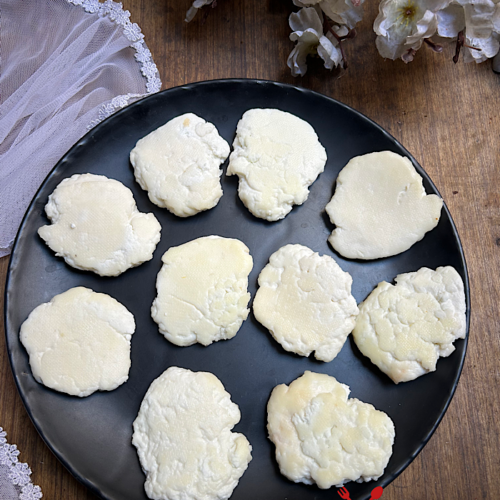
kaladi | kalari cheese recipe | famous food of jammu and kashmir

Made from milk, kaladi is a ripened cheese which is a very dense & is usually sauted in its own fats.
Ingredients
MAIN INGREDIENTS
- 4 Liters Raw Milk (We have used Buffalo's as it is rich in fat. You can use Cow's milk also)
- 1 tsp Citric Acid / Taatri / nimbu sat
Instructions
- Take a deep pan and add water in it. The purpose of adding water is that it prevents the burning and sticking of milk at the bottom of the pan.
- Then add milk.
- Start heating the milk. You don't have to boil the milk. We repeat, don't boil the milk.
- (TEST: To ascertain whether the milk is sufficiently warm is to put your finger in the milk. When you can feel the warmth but no trouble in keeping the finger inside milk for atleast 15-20 seconds, it is done.)
- The moment milk is warm, immediately switch off the flame. Better remove the pan from gas stove.
- Add citric acid and stir the milk. (see notes below if don't have citric acid).
- After 2-3 minutes of stirring, you will see that the milk will separate from the water. The texture of this milk will be quite creamy.
- Sieve this so that milk solids and water get separated.
- Then take a handful of this separated milk solid on your palm, wisely press it to squeeze the water and give it a round shape, though its edges are not supposed to be clean. This is your kaladi.
- Keep making all the kaladis and arrange them at a place where there is a way out to drain the leftover water present in the Kaladi. We are using a big mesh lid.
- Kaladi may take 2-3 days in getting dry completely, rather more days during winter. However after couple of hours when Kaladi stops dripping water, you can transfer it in refrigerator.
- Kaladi is ready to be cooked.
Video
Notes
- You may reduce or enhance the quantity of milk depending upon your need of number of Kaladis.
- Though we have used the citric acid to curdle the milk, but you can also use lemon juice or vinegar for the purpose. However using whey water is the traditional method to curdle the milk for making Kaladi and this is how shopkeeps do.
- We have mentioned that Kaladi takes about 2-3 days in getting dry and only then it is cooked. However we would let you know that the shopkeepers who prepare Kaladi start selling immediately after 2-3 hours of making it and they don't wait for 2-3 days. And also Kaladi is being cooked by many even when it is still wet. We advice you to wait for letting it get dried first. But if you can't wait for 3 days, then at least give it 8-10 hours to drain whole of its water.
- Don't discard the leftover water as it is full of nutrition and proteins. Use it for making dal, cook rice or knead a dough. However you can make whey soup too.
- The size of your kaladi is your personal choice. We made medium sized 10 kaladis out of 4 litres of milk.